Malaysia has officially entered a new era for stamp duty compliance. As of January 1, 2026, the Inland Revenue Board Malaysia (LHDN) has launched the Self-Assessment Stamp Duty System (STSDS), shifting the responsibility of assessment directly to the taxpayer.
This transition is in line with the nation’s digital transformation agenda, establishing a digital-first, self-compliance framework that encourages greater precision and proactive management from businesses and individuals alike.
To ensure you navigate this shift without costly errors, here is a breakdown of what you need to know about this new era of compliance.
1. What Is Stamp Duty?
Stamp duty is a tax imposed on instruments including written documents in the form of handwriting, typewriting, printing, electronic record, or transmission which is an electronically readable format, instead of the transaction itself.
In the past, businesses could take a back seat while LHDN handled the heavy lifting of assessing the instruments, calculating the rates applicable, identifying the party responsible for payment, and managing the procedures for stamping.
However, that era of passive compliance is over. Under the STSDS, taxpayers must now proactively file stamp-duty returns via MyTax portal. Once submitted, it is deemed an assessment unless the collector elects a formal assessment. Taxpayers are also subject to all obligations, including record-keeping, filing and making payment. Any failure to comply will expose them to increased fines and audit risk.
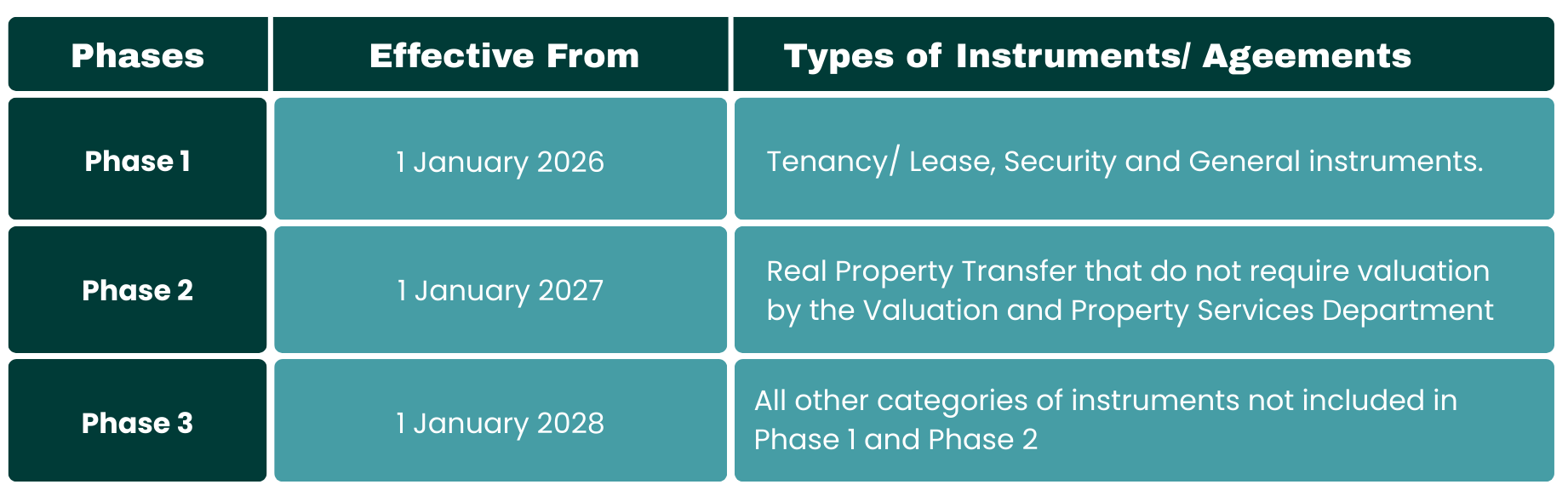
To bridge the gap between the old way and the new, the STSDS will be rolled out in 3 phases:
2. Navigating the e-Duti Sestem (e-DS)
The old Stamp Assessment and Payment System (STAMPS) will be terminated and all taxpayers are required to shift to the e-Duti Setem (e-DS) on the MyTax portal.
Access the e-DS by following these simple steps:
Step 1: Access & Login
-
Visit the official MyTax Portal.
-
Log in using your Tax Identification Number (TIN) and password. On the main dashboard, navigate to ezHasil Services > Duti Setem > e-Duti Setem.
Step 2: Choose Your Role
-
Option 1: Individual (Individu): If you are signing the document yourself (e.g., a tenant or employee).
- Option 2: Agent/ Admin (Ejen Admin/ Ejen): If you are a lawyer, secretary, or designated HR/ finance officer filing on behalf of a company
Step 3: Fill the Digital Return (BNDS)
-
Click Borang Permohonan > Penyeteman.
- Select the Instrument Category (Permohonan Penyeteman). For 2026, this is usually Tenancy/Lease, Securities, or General Stamping
- Enter the document details:
- LHDN office (Pejabat Setem Negeri): Office where STAMPS used to be processed physically
- Execution date (Tarikh surat cara/ tarikh surat cara ditandatangan): The date the document was signed
- Instrument: (Nama Surat Cara): Type of documentation
- Parties involved (Maklumat pihak pertama/ pihak kedua): Name, IC/Passport/Company registration, and TIN of all parties
- Contract details (Maklumat Surat Cara): The value and length of the contract
Step 4: Upload and calculate
-
Upload the PDF of the signed document and the system will perform a real-time calculation of the duty payable
- Review your draft: Double-check the figures. Under the STSDS, once you click "Submit," it is legally a Deemed Assessment.
Step 5: Payment
You may make the payment within 30 days of the document date via:
- FPX (Direct online banking)
- e-TT (Electronic Telegraphic Transfer)
- Bill Payment (Via CIMB BizChannel or Public Bank)
Step 6: Print Your Stamp Certificate
-
Once payment is confirmed, the system will generate an Electronic Stamp Certificate.
- Download and Print: You must attach this certificate to your original document.
- Record-Keeping: Save a digital copy! You are required to keep this and the supporting documents for 7 years for audit purposes.
3. Penalties for Non-Compliance
While LHDN will not impose penalties for documentation or assessment errors during the first year of the STSDS implementation, these weavers are not applicable for late stamping.
Taxpayers who fail to stamp their document within 30 days of execution will face the following charges:
- Within 3 months: RM50 or 10% of the duty (whichever is higher)
- After 3 months: RM100 or 20% of the duty (whichever is higher)
Beyond late payment fees, failing to stamp an instrument without a lawful excuse carries a heavy price. Under the revised Stamp Act, the fine for executing or signing an unstamped document has been increased from RM1,500 to a range of RM1,000 to RM10,000. Importantly, this penalty applies on a per-document basis; in a high-volume business environment, a small oversight across multiple contracts could lead to significant financial exposure.
In conclusion, the transition to the STSDS is more than just a digital upgrade, it represents a shift in responsibility and accountability. To safeguard businesses, strong internal controls, updated staff training, and a proactive approach that anticipates LHDN’s audit-focused environment are essential.
But you don’t have to navigate this complex transition alone. At Thelyx, we provide the expert oversight needed to ensure accurate filings, keeping businesses compliant and audit-ready.
Contact us to learn how we can support this transition.